I Worry More About the Lack of Natural Intelligence Than the Excess of Artificial Intelligence

- Published
A great deal has been said about investment in Artificial Intelligence around the world and, more recently, in Portugal too. It excites some people, worries others and, in the middle of all this discussion, there is something that worries me considerably more than the speed at which the technology is evolving: how little attention we are paying to human intelligence.
Over the past few years I have noticed a decline that seems increasingly clear to me in skills that ought to be basic: critical thinking, creativity, common sense, curiosity, the ability to question what we see and hear and, above all, the ability to think.
A wooden ramp at Portinho da Arrábida
This is particularly visible in digital environments, perhaps because that is where we come into contact with far more people, opinions and behaviours, but it does not happen only online.
This weekend, for example, on a visit to Portinho da Arrábida, I could not help noticing one of those spots that have become very popular on social media. A wooden ramp where many people stop to take a photograph that gives the impression they are falling down the mountainside.
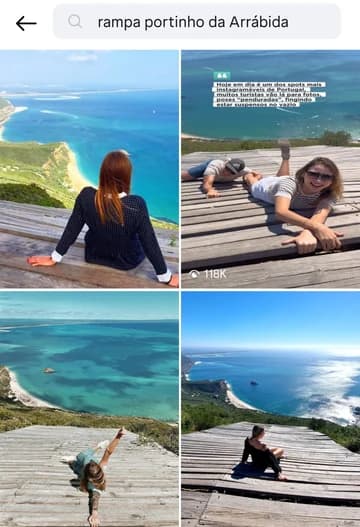
Beyond the queue to take a photograph, what caught my attention was seeing a mother with three children, one in her arms and two by the hand, approaching that drop of tens of metres to take pictures. I do not know exactly what happened afterwards and I also do not want to pass judgement on that family in particular, but I spent the rest of the journey thinking about it.
We are in the middle of the Serra da Arrábida, a place where you can get an extraordinary photograph from practically any point! And even so, there is something that drives ordinary people to literally risk their own lives and their children's for a photo that, beyond a few likes, adds nothing to their lives.

This story is not really about Artificial Intelligence, and not even necessarily about technology, but for me it helps to show something important: when the digital world evolves faster than our capacity to understand its effects, weigh incentives and make good decisions, we may have a problem.
And this is somewhat what worries me about Artificial Intelligence too.
I am not so worried that the technology is becoming too intelligent. I am more worried about the possibility that, at the same time, we may be exercising our own intelligence less and less, precisely those capacities that allow us to use any tool better: creativity, critical thinking, judgement, common sense and the ability to tell what makes sense from what merely looks like it does.
The more powerful the technology we place in people's hands, the more important these capacities become. And this is where I think we sometimes oversimplify the conversation.
The problem is not the tractor
Here is a simple example: I do not know how to drive a tractor. If tomorrow I buy a top-of-the-range tractor, with more power, more technology and every system available, I do not automatically know how to plough a field or work the land.
I end up with an extraordinary machine in my hands, but I still do not truly know how to use it and the opposite may even happen: the more powerful the tractor, the faster I can lose control and the greater the damage I can cause.
The problem, in that case, is not the tractor. It is the gap between the capability of the tool and the capability of whoever is using it. With Artificial Intelligence, exactly the same thing happens.
We can have access to the most advanced models in the world, to agents capable of carrying out tasks for us and to systems that write, code, analyse, research, create images, make decisions and automate processes, but that does not automatically mean we know what to ask of them, whether what they produced is correct, whether the decision makes sense or even whether that was the problem we should have been solving.
The investment we rarely talk about
This, for me, is where an important part of the Artificial Intelligence discussion sits, one that we often leave in the background. We talk a great deal about how much we are investing in Artificial Intelligence and very little about how little we are investing in our own intelligence.
And I am not talking only about money. I am talking about learning, about continuing to study, to read, to experiment, to debate ideas with people who think differently, to create, to get things wrong, to change our minds, to stay curious and not to automatically accept whatever appears on screen just because it is well written and sounds convincing.
I am talking about continuing to exercise capacities that we can easily start handing over to machines without even noticing.
Any technology that evolves faster than our capacity to understand and use it can become a problem, not because the technology is bad, but because we are still the ones deciding what we do with it.
Keep learning
That is why I continue to believe so strongly in lifelong learning. Not only to learn how to use Artificial Intelligence, but to keep developing what is most human in us: creativity, critical thinking, judgement, curiosity and the ability to learn.
Whatever the technology brings us, continuing to learn is, for me, one of the best guarantees that we will remain part of that future, as protagonists, rather than merely watching it go by.
Perhaps that is the investment we should be talking about a little more. Have you also been feeling that technology is evolving faster than our capacity to keep up with it, with common sense, critical thinking and human intelligence?